Friday, June 18, 2010

First Person Blogs

Some blog entries are easy to write. Others, for no particular reason, I agonize over and the writing just comes out all stilted and weird. This is one of those posts. I am determined to put it up though! So here goes:

Among all my blog searches, rss feeds, and quest for all things Living History related on the internet I come across some beauties every once in a while. Today I want to tell you about blogs from the first person perspective. Yup, blogs written as if they were in a different time, far removed from our own. There are basically two different styles these blogs can take: actual historical text, just digitized in blog form; or reenactors and modern folks writing as if they were a historical character.

Historical texts
Every day I learn about more and more primary source material that is being digitized and made available on the web. Most of these are in archives or library collections, but some of them --particularly those that were written as diary entries in the first place-- are put up bit by bit, blog-style. A blog that I have been enjoying written by "Two Nerdy History Girls" had a post that contains a good list to be starting with here check the comments of this post  too, tons more are mentioned.

Modern Interpretations
There are a few reenactors out there that are writing blogs from the perspective of the persona they are portraying. My favorite is this colonial impression and this later impression, of a doctor both done by the same individual. He wavers between totally history based posts, and some the wink at the current era, but I find he does a great job balancing both.

There are a few blogs that I’m not sure if the writers are reenactors, or what their relationship is to the history they are writing about this Mozart blog is a bit of a mystery to me, but still fascinating. A now solved mystery is about the author of Geoffrey Chaucer Hath a Blog in fact, there was so much mystery and hype about that blog, that a bunch of medieval scholars have written a book about it! I have not yet read the book, but it is on my Amazon wish list!
Read this entry on entry page

Tuesday, June 15, 2010

Early Inspirations

As a senior in high school and my first few years of college I did not do much with history. Distracted by grades and friends, I did some of the normal teenage things, but I still dabbled in the historical arts. I took classes in the history of science, which seemed the most engaging and interesting way to study history (high school and Freshman hist. classes are not, generally the most riveting classes.) I still did class projects that involved my own historical interpretations – dressing up as Marie Antoinette, and writing a Hesiod style epic poem on Pandora, with a feminist twist.

And, while working at a local bookstore I picked up a notecard with a painting on it. A painting called “The Shepherdess", that seemed to me to leap off the card and speak to me about a girl and about a place and time in history. I knew enough even then to realize that the painting the notecard depicted was a Victorian representation of a much older time, but I still loved the image. I wanted to step into the image. Even if the girl was only wearing a costume of an older time, well that was exactly what I wanted to do. I wanted to wear that costume. I wanted to stare soulfully at an artist, walk the path with a herd of sheep. I always pictured it to be set in a dusty corner of France in mid-summer. I purchased the notecard, and pinned it up in several dorm rooms and apartments for years after.

The painting of which I speak is one of many Shepherdess paintings by William Adolphe Bouguereau, this one done in 1889. I still plan some day to make myself that outfit, and try to capture a historical moment akin to what Bouguereau captured, and what drew even my distractible teen-aged self into a world where the past and the present slide a little closer together. Read this entry on entry page

Tuesday, June 1, 2010

Positive Interactions

A bit ago an acquaintance of many years remarked on the fact that us renfaire performers (and even the merchants (we’re all performers at the renfaire)) are great at creating the illusion of intimacy. We are inviting and engaging, we walk up to complete strangers and ask them to participate in our lives, or our made-up lives. After years of training folks to do this, we’ve had people come back and say that they are better at their real jobs, better at working retail, better at communicating with clients, than they were before learning how to be a renfaire performer. Renfaire folks quickly get over their fears of approaching strangers or they do not last as performers.

We are also trained to go with the flow. There is a popular renfaire training game called: “Yes, and…” where you are forced to agree with the most outrageous statements, then expound on them. It means you can throw weird scenarios at us and we’ll probably toss them right back. I’ve got a friend who says wacky things to see what other people will do, so the other day he asked me what would happen if rain fell up from the ground instead of down, I said we’d all have to wear clown shoes to keep dry. He thinks it is one of my endearing habits, that I can keep up with him in a conversation, I think it is partially training.

A while ago on the radio there was a story about a troupe of improvisational actors who create their own reality and invite others to participate in New York City. The scenario that the radio show particularly concentrated on was a fake birthday party for an unsuspecting bystander. The entire troupe went to a bar, picked a mark, and threw him a birthday party, like they knew him. They picked a fake name, made up a backstory, and everyone gave him giftcards and paid attention to him all night. Their mark protested for a long time, but even after he stopped trying to tell them that he was not who they thought he was, he still felt awful and like reality had skewed on him. I have to imagine if you had put a renfaire performer in that spot, they’d have absolutely no problem being someone else for the night.

Does that make us skewed, just because we could easily fall into someone else’s fake reality? Does it give us an edge that we can engage with complete strangers? I am by no means suggesting that there are not people in the world who do this naturally. Really effective sales people,  nomads and travelers, group organizers all have to have a level of empathy and consensus building. Is it worse somehow if some folks are trained to it instead of developing it on their own? I know I am grateful for the training.

Read this entry on entry page

Thursday, May 27, 2010

The Stages of Historical Accuracy

I’ve been having an online conversation about accurate items, that not only look right from afar, but are constructed using historical methods. Also this past weekend we learned that this fall’s Connecticut Renaissance Faire will be open into the evening: until 8 pm on certain evenings, so we’ll need to add historical lighting methods that will not burn the camp down. I had quite an involved conversation trying to convince a guild member that we could acquire period-looking implements in the next few months. Both conversations sparked a thought pattern about the “stages” of reenacting. Just like the stages of teenagers or the stages of grief when we are building our living history kit and props we tend to go through stages. Sometime we combine stages, or skip a few, but I think many of you will find these fairly familiar. In fact, even once we have established ourselves on the path to historical accuracy, sometimes adding just a little new bit (like, lighting, say) you might have to go through at least some of the steps all over again. And really, we’ll never be spot-on there will always be room for improvement.

1.    They did this so I will do this.
When first starting out we were probably all pretty sad in our attempts to mimic history. We often got only the basic gist right. We do things like, say: they wore corsets back then, so I will wear a corset. The first attempt we’ll probably end up in a corset from the wrong period, made out of the wrong materials, we’ll wear it on the outside instead of on the inside, but gosh darn it, they worse corsets so I am too. Or maybe you said: they hunted with bow and arrow, so you go to the sporting goods store and get a modern compound bow, a Native American style quiver, and a Robin Hood hat for accessory. This is a good and natural first step, and should be mocked only gently and with the passage of years.

2.    Others reenacting something similar to me did it this way.
OK, we’ve figured out the corset looks wrong, and someone hissed at us that that bow is too modern. We’re taking the next step down the path to historical accuracy. Luckily, many people have trod these paths before us, and some are willing to sell us all that we desire, or look good in their own portrayal and are willing to share what they know. Amazingly, there are quite a few conventions in the Living History world, that have little to do with historical accuracy. Viking chairs stick in my mind; one medieval reenactor thought it was a good way to make a chair, and had some info to back it up, now the darn things show up in all sorts of reenactments from a thousand years worth of European history. Eventually we all learn this lesson: even if another reenactor says it is right for your period, ask for documentation, or search for your own documentation, cause they may not be right!

3.    I saw something that looked similar in a woodcut.
Now we’re getting down to it. We are not content to read about it in books, or copy the other reenactors, we want to copy the people of the time, or at least look like they did. So let’s look at pictures! Photographs are all well and good after a certain date, but what if you are reenacting something before folks had the capability of photographing every little thing? Well there are still visual representations in the form of paintings, woodcuts, illustrations, sculpture. But just because all of Lucas Cranach’s women wear red dresses does not mean every woman in Saxony in the 16th century wore red. Still, we’re getting closer, especially if we use more than one visual source, say both a painting and a woodcut, from a relatively small timeframe and geographic area around which we our portrayal springs. Once you’ve got the look down, you’re moving along nicely, but we’re not there yet.

4.    They used these materials
That beautiful flowing dress, just like all the tapestries, and that funky shoe, just like all the woodcuts are still going to come off as not quite right if the dress is polyester and the shoe is vinyl. OK, that might be an extreme example, but we’ve all seen folks make something really pretty, but out of the completely wrong materials that make everyone feel slightly uncomfortable. This is especially true when one uses modern synthetics, but is still true even if one is just using the wrong type of wood in your woodworking projects, or a different type of clay in your ceramics. In our guild, we use a lot of redware pottery, because we’ve got a good supplier. We’ve got more evidence for whiteware pottery though, so over the next while I hope to replace a lot of the redware. Since pottery has the tendency to break with rough handling I’ll probably replace what I’ve got as it becomes necessary to do so.

5.    This was constructed using period methods, from an extant piece.
Since we’re talking about reenacting and re-creation, and not using actual historical pieces (see this post for my opinions on that) we are creating, or commissioning objects from the past. Once you’ve already gotten so your things are looking right, and feeling right, there is still another step down the road to historical accuracy, and that is making those objects using period constructions methods. It will not really be right, until it is made in the same method that it would have been made in the time and location you are portraying. We are not always able to do this, it cost more money, takes more time, and sometimes is simply unavailable, but everyone striving for accuracy will sigh and moon over this stage, even if not all of our items ever achieve it.

******
Different portrayals of mine have different levels of accuracy, heck, different items among my historical stuff are at differing levels, even if I use them for the same portrayal. There sometimes comes a point where I will tolerate different levels and not others, and certainly not all in the order that I have listed them here. But the stages are good for me to think about when I am thinking about picking up any new item to add to my stash.

Read this entry on entry page
Friday, May 21, 2010

The Most Popular Thing in Camp

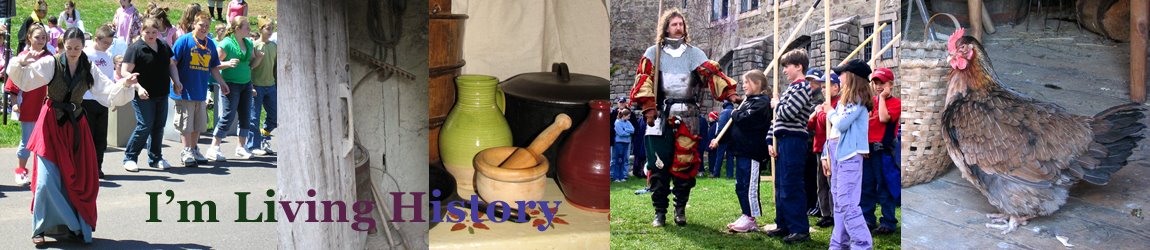
A few Mondays ago at the Connecticut Renaissance Faire’s spring show was School Day. The day when buses of kids descend on the grounds for mayhem and a little bit of learning if we can cram it past their stimulation soaked brains.

I have plenty of experience with school groups in historical settings, At Strawbery Banke I enjoyed field trips when I was a regular interpreter (tour guide) but had a few bad experiences as a costumed role player. At Plimoth Plantation I was only working in the gardens, not in costume, so I’d hide in the decorative borders and weed or water while observing the flustered teachers trying to line up their kids and follow all the rules in order to get them through the visitor center before the kids could even get to the 1627 village. Then I’d watch from the herb garden and the nature walk as the kids screamed past on their run to the village itself. For two years I ran CTRF’s school program. This time was my first in the encampment on school day. The experience was different from what I expected, and it was the same.

At the faire our encampment is set up on a back row that has only the games, a couple of stages, and us. It is a wide, grassy row with plenty of visibility and no shops, so you can tell that our set-up is different from a long way off. In fact, I’d say a lot of the kids never made it into our encampment. I know that the rowdy groups I heard about and encountered when I ventured out of camp either calmed down before they got to us, or didn’t bother stepping inside our camp. Since we’re set up in a very open semi-circle people come in and have a good view of all the things on offer. Ilsa and Wilhemina were tending the fire with Magda, who was also beading some paternosters. Sibalda was doing some copperwork at her worktable, Albert spent a lot of his time standing at the gate with a pike (and showing off the military prowess of the Landsknecht,) Gustav spent most of his time on the stage not too far off with his kid’s show called Master At Arms. I cycled around as needed and spent a lot of time sitting on a bench in front of the Houptman’s tent, which we had open a bit so people could see inside, and so Stephen’s dog Freke can see out, and get his share of the attention.

And that is one huge share.

Freke joined us on site last fall on dress rehearsal weekend, but we had planned during the faire itself to tie him up at the treeline in the wooded participant parking lot, behind all the trailers where he would not disturb anyone. We thought we were not supposed to have pets on site during open hours. But one of the owners likes dogs and saw him in camp during dress rehearsal, saw how well behaved he was, and decided to let him stay in camp for the run. One of our friends made him a metal studded collar (round studs, they just look pretty, they are not painful) and we tied him to one leg of the rope bed (much safer than tying him to a tent pole.) All through the fall he guarded the entrance to the Hauptmant’s tent, and proved a very popular addition to our camp.

He was the hit of this spring’s school day. Folks would come in and make a beeline for the cook fire, but when it turned out we were only boiling turnips, they’d spot the dog and run for him instead. Freke was great. He stood at the door of the tent, at the limit of his rope and wag his tail and stick his tongue out the side of his mouth. Some asked if they could pet him, I told those folks that he liked to lick, so they would get licked if they petted him. Most kids did not mind.  They would kneel in front of him in big groups and pet his head, scratch his back, and get him to shake hands. He has a horrible habit where, if you stop petting and turn away he puts a paw up on you to remind you to pay attention to him. It is incredibly endearing the first couple of times, and most people who do not know him find it charming, while Stephen and I have to put up with it every evening whenever he wants attention.

One group of kids that came to visit the dog took a look inside the tent and said: “look, this is his house, and there is his bed.” Meaning the tent and double size rope bed was for the dog. I corrected them, that it was my husband’s tent, and our bed, that the dog slept under the bed at night. A few made silly remarks about folks having dogs in the Middle-Ages. The most memorable group came by with a worksheet I wrote up a bunch of years ago, called “You’re the Journalist” it is a series of questions they are supposed to ask a “person on the street” i.e. a participant at faire. A human participant. The entire group interviewed the dog.

Now, I was stationed near the dog at the door of our tent to both keep people out of the tent (because part of it still has modern stuff in it, blocked off so that it is not visible from the door; and because we’d rather our nice stuff not get stolen) and to make sure the dog behaved. He is still a dog, and a rescue dog at that. He loves people, but we are never completely confidant that he will not react badly, or that a stupid person might not be mean to him. So all these people with worksheets could have interviewed anyone in the camp. Heck, they could have interviewed me and petted the dog at the same time. But no, they wanted to interview the dog.

The first questions is: “Are you a noble or a peasant?” the kids asked each other, but I butted in figuring if this is going to be the way it is I’d cram some information in there whichever way I could. I answered that Freke’s master is a baron, so that makes Freke a noble dog. They then asked me: “How does Freke spend his days?” “What does he eat?” “What would he do if he met the king?” For the last one I said that we are very respectful of the king so Freke would sit, or possibly lay down just like we would bow or curtsey. The last question on the shees is: “Do you have any advice for me?” so the kids asked me if I thought Freke would have any advice for them. I said he would probably tell them to pet him some more and be nice to dogs. Well, it is some sort of lesson, right?

I have told a lot of people the story of the kids interviewing the dog, and I think I’ve figured out why the dog is so popular. He is entirely approachable. To kids it is tough to approach adult strangers, especially ones that are dressed up and talk funny. That is why kids in costume in Living History situations will sometimes be mobbed by fellow kids. Well dogs are also approachable, they are not adults. Heck, other than a leather collar Freke is not dressed up either. He just pants and sticks his tongue out, and licks hands and faces. In a world of strange experiences, sometimes something familiar and non-threatening is just what the kids need as a key to unlock everything else.

Photo at top of CTRF’s Robin Hood Faire School Day. Photo in middle of our youngest guild member with her favorite pal Freke taken by Jennifer DeBeniditto.

Read this entry on entry page