Showing posts with label 12th Century. Show all posts

Wednesday, June 6, 2012

Monologue-ing

When all dressed up and portraying a historical character confronted with members of the public, it is a good idea to have a little bit of monologue explaining who, what and when you are. It helps your audience have time to look around, also to let them know some important facts (never assume your audience knows anything.) A short monologue can ground them, but I also find it helpful to get me in the mood for sharing information. I am actually a very shy person, and sometimes I need a reason to open my mouth and be outgoing just as much as the audience needs to figure out what is going on.

Now by monologue, I don’t mean something long and boring. The old Strawbery Banke rule for tour guides was that your introduction to the history could not be more than two minutes long. I think that is too long for a beginning introduction before you toss focus back to your visitors and find out what they are interested in. I generally like my introductory monologues to be roughly three sentences in length and either end with a question or some other type of conversation starter that the people you are conversing with can latch on to.

A few months ago at the FPIPN retreat, Ron Carnegie, who is George Washington at Colonial Williamsburg started his talk with a pet peeve that he called the “Wikipedia method” of first-person interpretation: Where the presenter sounds less like a real person talking to other real people and sounds more like the entry in a dry encyclopedia. “Hi, my name is ____ I was born on March 18th in a small town outside ____. When I was 18 we moved to ___ where I was to meet my future ____.” Just a list of dry facts. I actually recently heard this done. Not quite as badly as all that but the person really did say: “my name is ­­____ this is my house and the year is ______.”

It sounds so fake! Most people don’t really talk like that. I’ve thought back over some of the times I’ve had to introduce myself to people, to groups, and there are definitely ways to introduce yourself and the historical setting that are much less awkward. One of my fellow Mrs. Shaprios at Strawbery Banke has a basic introduction that sounds like this: “Hello, my name is Mrs. Shaprio, welcome to my home. My husband and I purchased this house 10 years ago in 1909.” I think this is a fairly brilliant way to get the date across. Easy math, that also tells you something about the character and her social status. Sometimes she even adds: "That was just a few months after our daughter Molly was born." More info, not a lot of fuss. As Mrs. Shapiro I often endow people as potential renters since the Shapiros rented the third floor, it gives me an excuse to talk about the house, and a reason to invite them to look around the rest of the house.

This spring Stephen and I spent 4 weekends at the Robin Hood Springtime Festival mostly with Stephen working Saturdays and me working Sundays. I usually arrived tired, and proceeded to spend the day getting progressively more exhausted. Couple that with the small attendance, and I don't feel like I ever really got into the swing of an opening monologue about my 12th Century character: Rose I got good at explaining about the encampment, the tent, food and herbal medicine, but I don't feel like I really found Rose and her relationship to all these strange people she meets when the lord is on the march. I guess that is a good excuse to find other places to set up our 12th Century encampment.


Read this entry on entry page

Monday, March 19, 2012

That Blanket Has Character!

My mom is a connoisseur of yard sales, thrift stores, and flea markets. This works out great for me, because I’m not much of a shopper. It works out especially well when I’m looking for reenacting stuff, because it is very rare that we can find what we need at modern stores. Mom is willing to take requests: right now she is looking for wooden boxes for me, and if she sees nice linen table cloths, or wool blankets, she knows I am always interested in those.

When Mom showed me this particular blanket I fell instantly in love with it. It is hand woven, on a fairly narrow loom, and was pieced together from three narrow sections. The warp is wool, and the weft is (probably) cotton. The stripes don’t match up entirely and it has worn very thin in parts, and that adds to its appeal.

Last fall I tossed it on the bed with all the other blankets, hidden somewhere in the middle because it does not really fit with out upper-class portrayal, but it was warm and I was not going to leave such a charming blanket at home. Recently when getting ready for the upcoming reenacting season I pulled out our blankets for their spring airing and decided that if we were going to abuse the blanket with use, I should patch up some of the bigger holes. I read a blog entry about mended French fabrics last summer, and when looking at this blanket the pretty patches and darns instantly came to mind. We’ve got a much lower class portrayal in our near future, so I went to the scrap bag, and pulled a bunch of colorful wool scraps from various sewing projects.

I particularly like to do hand sewing in the evenings when I’ve used up all by brain power for the day, but I’m not quite ready to go to bed. I take off my glasses, and curl up under the blanket (the part I’m not mending) and put another patch in place. I go to bed with a feeling of accomplishment. Even if I’ve achieved nothing else in the course of a day, at least I got a little farther on bringing this nifty little blanket back to usability, I’m adding my own touches as well as memories of past outfits, and in the spring it will keep us warm. Also, if anyone visiting us at any of our events gets close enough, they will get a bit if a surprise when they notice all the patches and additions, it is a bit of a reward for those who dare to look at the details.


Read this entry on entry page

Wednesday, March 14, 2012

Introducing Rose


A couple of years ago Stephen was asked to take part in a new faire put on by the owners of the Connecticut Renaissance Faire. They wanted a living history encampment for the new faire and we’d impressed them with what we’d done with Das Geld Fahnlein. They were looking at a Robin Hood theme, the kind that coincided with the story of Richard the Lionheart and bad Prince John, which gave us a chance to look at a new time period to reenact: the late 12th Century. It took us a few years after that initial request, but this May the Household of William Marshall, a Living History Encampment, will debut at CTRF’s spring faire. It will be a different sort of encampment than Das Geld Fahnlein: smaller, less military and more domestically oriented, and much more dependent on individual research.

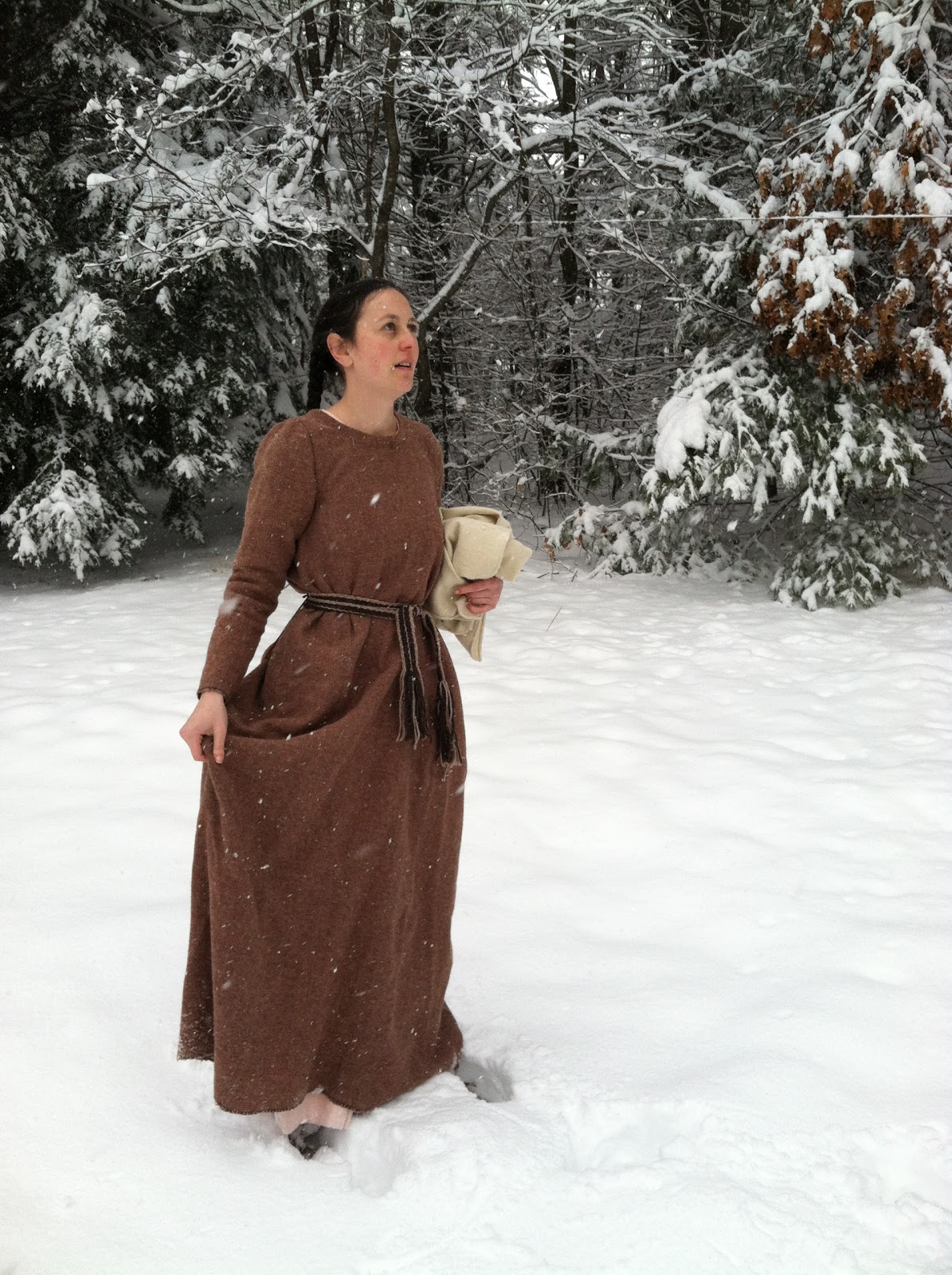
Stephen and I made the decision fairly early on that since we were the nobility in Das Geld, we would go for lower class in 12th Century. It would give us a chance to stretch a little and take some of the pressure off us in terms of performance and also our wallets. For the past couple of years I’d been portraying a farmwife as part of our Medieval Talk Show presentation in schools, and I was interested in exploring her further, so Rose is expanding from a generic farmwife into the wife of a huntsman and maker of herbal medicines. I don’t yet know a lot about Rose, that will come with more time in her skin, but I do have the outfit done!

Last May Stuart Peachey came to speak at Plimoth Plantation. I was able to attend one of his talks on food, and another on clothing. During the clothing talk Peachey mentioned big black wool coats worn by English farmers in the 17th century. He pointed out that the coats were not dyed black, but were woven out of the darkest sheep’s wool. You know the old nursery rhyme, right? It had never occurred to me, when looking through the woolens at the fabric store, that a really dark brown would be acceptable because that was the natural color of the fiber! Now it seems totally obvious, but when wandering around the store with historic dye samples, looking at modern wool, it is sometimes tough to get back to basics like that.

Underdress on top of the outer dress fabric.
Not long after attending the talks I read some great articles on weave patterns and natural colored wool for 10th Century Anglo-Saxon clothing, specifically the articles entitled: “A re-enactors introduction to “Dark Age” Textiles" and "An overview of textiles throughout British history” and as soon as I read them I knew my 12th Century outfit would be of natural colored wool in interesting weaves.


I started that spring with a square of natural “white” wool on which I stitched a rolled hem for a head covering. Then I looked for research materials and sources. I found very little. I ended up with The Medieval Tailor’s Assistant, which was only a little helpful, and Medieval Garments Reconstructed, which is a bit early, but contains extant tunics which all appear to be created along fairly basic lines. I’d done tunic-style dresses before, usually with lacing on the sleeves and back, and often with very full skirts, this dress would be even simpler.

Next I worked on a linen under dress. The fabric is very lightly pink, but I justified myself with the thought that linen does not really hold color well and it could have been dyed with madder and faded a lot. Since it was an under dress and I wanted to make sure the pattern I was using would work, I machine sewed the dress and used my serger for all the inside seams. Actually I did not so much have a pattern as a quick sketch by me, and a set of measurements by Stephen. He is so much better than I am at measuring the body and figuring out how much cloth will be needed to make something to fit that body. From those measurements I cut down the neck a tiny bit, and cut in the shoulders before I set in the sleeves, but other than that I did not need to change a thing.

Hand-sewing all seams on the hand-woven wool.
Stephen and I have quite a big fabric stash in our sewing room. When it came time to sew my outer dress I pulled all the lovely weaves in natural colors off the shelves, and discovered that most of the pieces were too small to make an entire dress. My favorite of the larger pieces was one of Stephen’s contributions to our stash, and since I had the suspicion that the piece I adored was hand woven I made sure to ask his permission before slicing it up. Stephen confirmed that the wool was hand-woven, probably by a friend he’d met in college who had passed away more than 20 years ago. I could totally understand the reluctance to cut into such a beautiful piece with poignant memories, but the moths were going to get to it, and I promised to use it well.

There was just barely enough wool. For a while I was worried that I would not be able to make arms for the tunic in order to get enough fullness in the skirts, but I squeezed enough panels in, and used every last bit of the cloth. I broke the historical rules and put the selvedge along the bottom edge, which gives it a nice line without hemming, and allowed me to get a dress that was just long enough. I ended up hand sewing the whole thing, partly as an homage to the memory of the woman who wove it, partly because the wool was such a dream to work with, it took the seams that I copied from the Medieval Tailor’s Assistant and made gorgeous lines that a machine never could have achieved.

With an under dress, an over dress and a head covering I was basically done. I had purchased shoes 2 summers ago, and have some nice belts I wove on my mother’s old inkle loom. I have a lot more to do before Rose is a full character, but her first outfit is complete.
we only got one snowstorm, and I was in it!


Read this entry on entry page