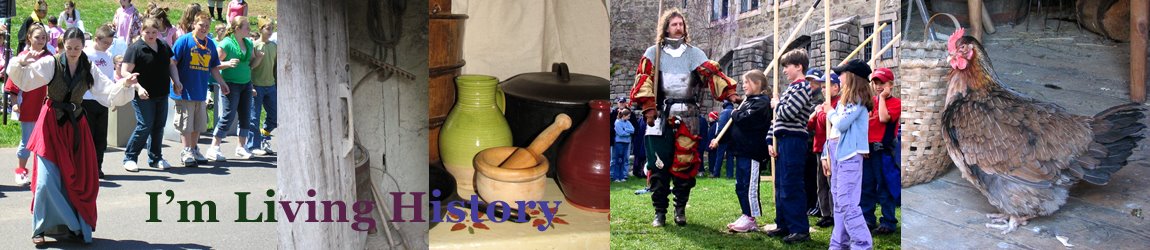
Showing posts with label theater. Show all posts

Wednesday, March 15, 2017

Midwinter Mischief at Old Sturbridge Village

Stephen and I went on a Midwinter Mischief tour at Old Sturbridge Village on February 4th. It was their first day of the special program. We went on an afternoon tour, but it was still the first day of a new program. The program was a semi-guided tour, with a meal included for $20 for non-members, which is a very decent price.

From the OSV visitor center we were lead by a costumed guide who walked us across the village to the Bullard Tavern. He stopped us halfway through to recite a verse about the experience we were about to have. He was very awkward, dropping his lines and struggling with the tempo and rhyme scheme of the verses. I got the impression this was not his idea of a good time. But when we were met at the tavern by “Mr. Bullard” he was enthusiastic in his acting. He encouraged us to eat first and assured us we’d get on a tour, but we declined since we’d eaten in the car on the way down. After using the restroom, we asked where we could catch our 1:45 tour, it turned out the 1:30 tour had not left yet so we jumped in on the end of the orientation for that tour.

The orientation was lead by the “town gossip” who was very good at making everyone laugh as she handed out cards to each person with the “role” we would be playing. Everyone got a nicely printed glossy card with a silhouette on one side and a paragraph about the role on the other. In the sitting room of the tavern another costumed person came in to tell us , in verse, about the peddler who spent last night at the tavern, ran up a tab he could not pay, and promised the tavern keep that he would return “with a tin cup overflowing with Gold”. The costumed person (who I’m told was supposed to be a tavern regular)told us the peddler then went to the Tinsmith shop, and we should go there to look for him. He did not follow us, but pointed the group in the right direction, we all walked ourselves (I think there were just under a dozen up is on this particular tour) over to the Tin Shop.

Inside the tin shop we were given some basic interpretations by the two men working in the tin shop, and one of them almost sounded like he was speaking in verse but it was so natural and interspersed with info on smithing and the history of peddlers that it was hard to tell. We spent about 10 minutes in the tin shop before they told us the peddler went on to the Parsonage, and we should look for him there. Over the course of the tour we visited:
- The Parsonage, grating chocolate with the parson’s daughter, getting a sermon on the evils of drink from the parson.
- A house in the village, helping dip candles,
- The village store, learning about what was sold there and buying on credit,
- The schoolhouse, getting a lesson
- The pottery, doing some hands-on wheel work
- The barn, sawing some firewood
- The farmhouse kitchen, making sausages
- Another kitchen, baking pies
- The blacksmith shop, shoeing oxen
- Outside visiting, with an oxen pair.
All of these stops were roughly ten minutes in length, all involved some interpretation, at least one hands-on opportunity for someone in the group, plus a few verses of script about “that pesky Peddler.” Each stop felt like a pretty good length, with a good mix of learning and story. None of the walks between buildings were so long that they felt arduous, and even though most of the stops the group had to stand, there were enough sitting stops mixed in that the general visitor did not feel too worn out by the end. We almost bumped into the group before us twice, but both times they were coming out as we went in, and we never ended up waiting for them. We never ran into the group behind us. Nor did it feel like the interpreter/actors were watching the clock, or rushing us through, their timing was very good.

After the last stop, our visit with the oxen, we were met by the last actor, a skinny young man in a top hat who did even more verse speaking, heading back up to the tavern. He was dressed quite differently from the other interpreter/actors, and was a better actor than most of them. Halfway through the walk back toward the tavern he produced a tin cup, giving the first inkling that this was the peddler we’d been “looking for” during our tour. For a little while at the end of the tour it felt quite clever, how the script had worked our group around to “discovering” the peddler, but by the time we got inside the tavern the clever part felt pretty empty.

My takeaway as we sat eating our soup (they’d kept some warm for us when I’d refused to eat before our tour) was that the “Midwinter Mischief” was a cute gimmick to get people on to the grounds during the month of February. The OSV actor/interpreters were the museum’s regular staff, and while a few did a superb job most of them gave off a distinct air of silly. They were portraying silly town characters, reciting silly lines about a silly peddler. This tour was not something to be taken seriously. In the end, everyone knew the peddler would come out on top, the town was no worse off for his visit, and there was no effect on the lives of real people, real history.

I think that did an incredible disservice to the history that they were interpreting. Every visitor was given a lot of information about life in a New England town in the early 1800s on this tour, but since the script was so gimmicky, and the actors so obviously just reciting their lines and not portraying real people, I believe it was hard for the visitors to go away with any emotional investment in what they had learned. Mystic Seaport does an incredible job using engaging emotional content in their programs, as do some of SBM’s roleplayers, so I know it can be done. Midwinter Mischief’s plot was fairly weak, and definitely came off as an excuse to visit the best houses in the village, not as an interpretation method itself. This could be because OSV hired a theatre person instead of a history person to write and direct their program, but I’ve seen amazing theatre that is emotionally engaging, so that can’t entirely be it.

I think the most I can say about the program is that it is a cute gimmick to get people through the doors, and show off the best of OSV in a winter setting. The worst is that there was so much potential if they had put more emphasis on actual history, and if their staff running the program had felt more comfortable playing their parts.

Read this entry on entry page

Wednesday, August 13, 2014

Fall Museum Plans

Even though it is still summer by most American calendars, fall and winter planning are well underway at Strawbery Banke. The two events that started off my career as Manager of Special Events are coming around again and I am super excited to add a little of my own creativity into them this year.

Ghosts on the Banke: last year I had only just started less than a month before our Halloween event, so mostly I was carrying out the vision of the last person in my position. "Ghosts" is a safe trick-or-treat that last for two hours per evening on Friday and Saturday the weekend before Halloween. It is a small budget event, and most of that budget is spent on candy so over the years it has gotten away from being a history event, though it is still about community. This year I'm going to try to bring a little history back, by enlisting the help of local theater groups: improv troupes, high school clubs, anyone I can find, to tell "ghost stories" or historical themed skits and scenes on the grounds during the event. I'm going to have to put in some miles tracking down groups to participate  but hopefully this will add a new level of community involvement, more history, and lot more life to the event.

Our holiday event: Candlelight Stroll is also on my mind. To this one I need to add more outdoor activity. This is not that easy to do in December in New England, but that is what I am hoping to do. I am trying to increase the number of caroling groups, or at least spread them out more evenly over the three weekends; I am hoping to work with local Boy Scout and Girl Scout troupes to get them involved, and I have been given the okay to hire more costumed role players!

The last one is the one closest to my heart, I've done so much historical interpretation, acting, role playing, whatever you want to call it, myself. I think it is a great way to bring history to life, and Renaissance Faires have taught me that it is also a great way to keep a crowd entertained. Since we have houses ranging in date from 1690 to 1950 I am looking forward to hiring people to portray all sorts of townsfolk from all sorts of eras. I've already written up the casting call even though I will not put it out until September. The next step as far as putting more costumed role players on site is to start in on the research, also tons of fun, and something I have missed doing! Read this entry on entry page

Thursday, January 10, 2013

Tools for Effective First-Person Role-Playing

When chatting with some of the other folks that were new role-players at Strawbery Banke one of them mentioned that when she started she had a hard time getting into character and talking to visitors as if she was her historical role. This is an incredibly common problem, especially since she was given only one set of tools in training: the historical record. Don’t get me wrong, the historical record is incredibly important. Without facts, historical documents and scholarly interpretation, we would not have a foundation, nothing to stand on. Knowing how to write does not make you a journalist, or novelist. You can have the best costume in the world, and know the most knowledge, but if you can not get it across to your audience then you are not an effective first-person role-player.

There are two other sets of tools that I think someone needs to be an effective first-person role-player: interactive improvisation, and educational presentation. I believe both of these can be taught, and that they should be taught. The new roleplayers at SBM were not taught about education, it is expected they know a bit about teaching before they get to the museum. And many “professionals” look down on theatre as fiction, it is certainly not serious study, like us role-players. But without being able to teach, and without interactive improvisation, I would be much poorer at what I do.

I’ll talk about education tools first, since I think these will be the easiest for most folks to agree with. Every teacher out there will tell you that there are skills needed to be an effective teacher, I think many of those translate to being an effective first-person role-player. Not every visitor needs to know the exact same fact, there are many different ways to learn, not everyone makes a good discussion leader. A teacher can tell you all this and a role player can use them to get across all those great stories they’ve learned through research. Modern folks can empathize with folks from the past, we can learn about ourselves by learning about where we come from. Sometimes just knowing that our jobs as roleplayers is not only to get across the past, but to teach it, to relate it in ways that are meaningful to our audiences can boost our effectiveness.

The third tool that I use in every visitor contact is interactive theatre (yes, I went to a posh sort of college and spell it “re”.) There is an element of acting in Living History portrayals. It is not the same as acting in a play, or movie, but interactive theatre is very different from those too. When the audience is right there interacting in the story, you need to be willing to throw the pages of the script out the window, but not loose sight of the underlying story you are telling. It takes flexibility and empathy; you need to be a good listener, know how to stay positive, and not be afraid to look like a complete donkey. Theatre techniques, practice, and yes, games can be a lot of help.  I promise your audience/visitors/MoP/students will never know.

I started doing this crazy dressing up and acting like a person from the past (i.e. first person roleplaying) nineteen years ago with a little theatre background, a little history research, and basically no educational training. Since then I’ve not only absorbed a lot of history and some educational theory, but I was trained in interactive improvisational theatre. I am a much better role-player for my training, and I think all of us role-players could continue to improve with more of all three.


Read this entry on entry page

Wednesday, January 14, 2009

Renaissance Faires, a Historical Fiction

I have been pondering the historicity of Renaissance faires.

Renaissance faires are most commonly weekend events, they are found all around the US, some in Canada, and are gaining popularity in Australia. Probably not surprisingly, special events on Medieval and Renaissance history can be found all over Europe, but the events that I am focusing on are a particularly colonial phenomenon. They vary widely in size, and intent from faire to faire. Some are long established, permanent enterprises, some are more ephemeral church or school fund-raisers. Faires also vary in historical accuracy, which is not necessarily related to size or any other factor. All Renaissance faires are based on festivals, markets, and celebrations in Renaissance Europe, but none of them intend to recreate life in a particular time and place with the accuracy expected of a museum. So where does that lead someone trying to make generalizations about Renaissance faires as concerns their historical basis or lack thereof? In quite a conundrum.

I’ve been working Renaissance faires for 6 years. Before being hired as a Stage Manager at a faire in 2002, my historical background was in museums. And now that I am expending more of my energy towards history and less towards theater I am looking to museums again. Today I find myself justifying my time spent at Renaissance faires to colleagues in the museum field. Many of these folks (who may or may not have ever visited a Renaissance faire) speak of Renaissance faires with derision, but are unable to tell me exactly what a faire is, though they all tend to agree “its not history.” The only response to these folks I’ve come up with so far is: the Renaissance faire is historical fiction.

I think the analogy between Renaissance faires and historical fiction is fairly solid, especially since there are so many forms of historical fiction: novels, plays and movies are most obvious. Historical novels, like Renaissance faires, vary widely in their portrayals of history. Middle schools use the novels of Karen Cushman to teach medieval history, but very few would consider novels like The Crystal Cave for teaching history, even if it is a great story. The same can be said for plays and movies. HBO’s series on John Adams, strives to be accurate within the confines of the mini-series, and is certainly more accurate than the movie The Patriot or the musical 1776, though all are based on the Revolutionary war, and all portray actual events.

Some Renaissance faires strive to include as much history as they can, training their actors in history and biography as well as interaction. Some have special days for school field trips that are more educational than the average weekend day. Some insist that only hand-made items be sold in the many shops and booths throughout the faire. But many more welcome the fairies and sprites of fantasy, celtic inspired art and goods, and entertainment that owes more to Victorian England (the 1800s) than Renaissance England (the late 1500s, early 1600s).

Renaissance faires share another important element with other forms of historical fiction: author/producer intent versus reader/viewer/visitor experience. Many authors will tell you that once they have released a creation into the world, once a story is published, each individual reader will bring their own interpretation to the book. No two readers will experience a story the same way, no two viewers will see a movie the same way, and no two visitors to the Renaissance faire, will have the same experience. Actually, this element is heightened at a Renaissance faire, where the many elements that make up the faire will all lead to varied visitor experiences.

At the Renaissance faire there are many varied live performances going on all day long, and no one person can catch them all. Just like at the mall, a person is unlikely to visit every shop, or shop for the same items. A large part of the Renaissance Faire experience is centered around personal interaction with the historical characters, so every actor tailors their performance to the people they are encountering at the moment, guaranteeing a level of personalization just not possible in books or movies.

So, can a Renaissance faire be called history? I think it can safely be called historical fiction. How historical is a Renaissance faire? Well, it depends.

I welcome your comments, please let me know what a renaissance faire is to you.

Photos, Top: Guild of Saint Michael lines up for parade, Bristol Renaissance Faire (photo by Alena Shumway), Middle: “Willow” the Fey of trees, Connecticut Renaissance Faire (photo by Jess Boynton), Botom: King Edward knighting a young visitor, Maine Renaissance Faire (photo by Rob Mohns.)

Read this entry on entry page

Friday, November 28, 2008

Tricks of the Trade, Endowments


A lady, medieval nobility by her dress, approaches a family in modern clothes who are looking around them with some enjoyment and not a little trepidation. She walks swiftly towards them, and almost past when she pauses, approaches the older man in the group and exclaims:

“Henry? It is you! Why Henry it has been quite a while. How long has it been since we last saw each other?”

Now the woman has the entire family’s attention, but no one, not even “Henry” responds to the question. She hurries on to explain:

“Henry and I knew each other many years ago. My father was arranging for us to be wed when Henry’s father found him a richer bride. And is this your family?”

This elicits a few laughs from the crowd, especially since the lady appears to be in her twenties and “Henry” is in his fifties.

The lady goes on to explain to those in the party who may not have met her before that she is the eldest daughter of a duke, now married to a count with three children of her own and she is looking for husbands for them. She solicits recommendations of what she should look for in a husband for her daughter, then bids adieu to Henry and his family, and continues on her way

The man in this story is not really named Henry, and the lady is not really a noble lady. She is an actor, and he is a visitor to the Connecticut Renaissance Faire, or any other number of immersive history events all over the US. But why in the world would a noble lady wander up and introduce herself to a large group of people when those people are centuries away from what she is depicting? By drawing the audience in and giving them a place in her world, she was able to enter a dialogue with this group of people, that hopefully did not feel too out of place or awkward.

The above endowment is fairly straightforward, a single person is given a name, a role, and a relation to the performer, but that is not the only type of endowment.

The tall, lean, mustachioed man approached the seated audience. He hooks his hands into his suspenders and asks for a show of hands:

“Now how many of you have brought your own horse today?” When no one raises their hands he asks how many have brought their shotguns. When this elicits a laughing response he asks how many have ever before participated in a posse before. While a few brave souls who have caught on might raise their hands Wild Bill still gets to say,

“Well we’re up against some pretty fierce cattle rustlers this time so you better pay attention if you’re going to survive as a member of this posse.”

In this case the performer playing Wild Bill has an captive audience, seated, waiting to hear what he has to say, but why in the world would Wild Bill Hickok tell his life story to these modern folks sitting in a modern classroom? Even though the life of Wild Bill is thrilling, the audience now has a stake in the story, much more than they did before they learned that they are a posse, newly deputized to take down the local cattle rustlers. This endowment has also established Wild Bill as a lawman. He is leading a posse to take down a gang of cattle stealers. He has done this in a way that seems much more natural than a more explanatory approach.

There are as many, if not more types of endowments as there are historical roles to play in this world. Some endowments only go so far as to establish the audience’s place in the performer’s world without getting into specifics of a name, or even a place in a posse. In fact, most interactions between performers of historical roles and a modern audience assume that the audience has a place in the character’s world. Sometimes this is gotten around by assuming the visitors are only visitors from another geography and not another time, that way they might still need the goings on explained, but they have not broken any rules of physics.

If you were living in 1627 Plimoth and a group of modern school children barged in, you’d probably react very differently than a historical interpreter does. Endowments get around this problem. Maybe they are a fresh boatload from the old country, neighborhood children that need to be taught, or settlers from other settlements in the new world. Sometimes we need to do some translating to accommodate modern sensibilities. A German tourist in a world war two museum would be incredibly uncomfortable if the first person characters treated them the way that many German Americans were treated during World War II. The German tourists at Strawbery Banke Museum’s WWII general store are greeted as refugees escaping the fighting or as allies, so they can have a meaningful conversation. There are very few situations when reenacting the prejudices of the past on to a modern audience will get your point across. Now I’m not talking about more theatrical reenactments, where all of the people involved are actors, then it can be very informative, like Colonial Williamsburg reenacting a tarring and feathering. The aggressors and the victim are actors, they have worked together towards a goal of greater understanding and are prepared to take the abuse. A modern audience needs a little more careful handling than that.

So the next time a funny dressed person rushes up to you and asks if you have seen their falcon fly by, play along. I bet you’ll learn more, and you just may have some fun too.

Photos taken at Reenactorfest in Gettysburg Dec. 2007, by Rob Mohns Read this entry on entry page

Saturday, November 15, 2008

Convergence: The Bog Man’s Daughter

In the 8th grade, my class was visited by a costumed performer portraying a Nineteenth Century Irish peasant. To this day I can vividly remember my reaction.

The 8th grade where I attended middle school had a great program, where all the students got to be Irish immigrants during the potato famine and we all kept diaries from the perspective of a real person who came to Boston during the mid-1800s. it was a fantastic learning opportunity, lasting for an entire quarter of the school year, and I’m sure I’ll be writing more here, since it was one of my first reenactment and living history experiences. but for the purposes of this post, it is enough to say that by the time it was over I knew a heck of a lot about the Irish potato famine for a 15 year old student from New Hampshire.

Later in the same year, once the program was over, but not over so long ago that the teachers did not think it was still beneficial, we had a special guest at our school. A woman came to our classroom to do a one-woman show called The Bog Man’s Daughter. I remember the teacher introduction barely, but it went something along the lines of: this woman is coming from the Museum of Science in Boston, she is a professional at the sort of stuff we’ve only been playing with. She is going to do a play about bogs and turf, which we’d learned about earlier in the semester, and about the ancient bodies that had been found preserved in the bog. In fact, the title, the bog man’s daughter game me the strong impression that this would be a woman portraying an ancient Irish culture hundreds, perhaps thousands of years before the stuff we’d studied.

When she stepped in to the area at the front of the room that had been cleared she pulled a piece of paper out of her basket, read to herself for a little then peered at is the audience and recited a line:

“I’m nobody, who are you?”

And I was instantly turned off. I was disgusted and disappointed. I felt justified as she continued:

“Are you nobody too?
Then there’s a pair of us
Don’t tell they’ll banish us you know.”

Now I don’t believe that many or possibly anyone else in my 8th grade class had the same reaction, because as far as I knew none of them had read poems by Emily Dickinson, and that poem in particular, before. I loved the poem and was upset that someone else was using it, but I was more upset that it was a nineteenth century American poem, and this woman was supposed to be from Ancient Ireland! Truly I do not remember much else from the show, other than I spent a lot of it thinking that I could have done a better job, had a better accent, been more consistent and certainly would not have started with an American poem, even if the word “bog” did appear at the end of the second stanza.

I have thought about my experience quite a bit, especially before I visit a classroom where I am in costume, in character, giving a lesson in a history I know and love. I know that we will not reach all students, but I certainly hope that we will reach most, and especially the ones that love history as much as I did/do.

This year as part of my readings for graduate work in Museum Studies I have read a lot of articles and books on museum theater (or theatre if you prefer) and two of them have mentioned the Museum of Science’s theater program, in fact, both of those have talked quite a bit about The Bog Man’s Daughter. The first article I read was in Case Studies in Museum, Zoo and Aquarium Theater. The article was written by the playwright, of the Bog Man’s Daughter and talked about finding a hook to make bogs interesting to a modern American Audience. The second was a book: Museum Theatre by the first woman who acted the part of the bog man’s daughter and for all I know may have actually been the person who visited my school. They both talk quite eloquently about bringing a vague topic (bogs) to life, from one of their most famous perspectives (the Nineteenth Century Irish maid.) They both mention the ingenious use of the Emily Dickinson poem, and neither of them find anything wrong with it, since the poem is read in a letter, supposedly from the character’s brother in America.

Did 8th grade me misunderstand their intent? yes, partly. The writer and performer had never meant it to be about Ancient Ireland but had always set it in the nineteenth century, and were fairly consistent about that. Did they misrepresent the culture even so? Yes, partly. The use of a well known American poem might have been initially put in because it is recognizable to many (and a fantastic poem.) But it put me off right out of the gate because Emily Dickinson is so tied to New England and America, so I had a hard time believing all the Irish stuff that came after that point, even if the performer had gone on to explain the poem’s place in her story. I didn’t buy it, so the performer had an uphill battle with me, and never quite won me back over.

We performers know we can not reach everyone, and for most of us knowing that we’ve reached even a few can make the performance worthwhile. But recreating history, when our audience has such a mixed amount of knowledge and tie to history, can be treacherous, in ways we may not first suspect.


Photo of Alena Shumway as Bess Brown, Photo by Jess Boynton. Read this entry on entry page

Thursday, November 6, 2008

Portraying a Historical Character: 1st person vs 3rd person

All of the people who portray historical characters: museum and school personnel, military enthusiasts, actors, costume lovers, and more, have an important decision to make when interacting with the public, and that is how to address their audience.

I don’t mean whether to be rude or welcoming, I should hope that we’re all encouraging new folks to get into history so we are always kind and open. I mean whether we will address our audience from the first person or the third person. For those of you who do not remember this particular English lesson, first person is when the story is told from a personal perspective “I went to the store”, third person is when the story is told from an outside perspective “She went to the store.” As a costumed interpreter of history we have a choice of speaking to our audience in the first person “I cook food like this” or third person “back then they cooked food like this.”

There is a raging, and probably never-ending debate on the efficacy of both types of interpretation, and they both have their pros and cons. I have seen both done well, both done very poorly, and I’ve even seen some very effective methods in between. I have been asked more than once, by friends and family on the outside, to explain exactly what the debate is, and why it is such a big deal. This is no small task, but there are some main points that I’d like to capture. I would also like to dispel the myth that I favor one type over another, the truth is that I think all sorts of portrayals have their place, and can be effective teaching tools.

First Person: the Immersive Experience
What could be better than going back in time and having a conversation with Mark Twain? Or stepping inside a colonial stockade and really being there?

Portraying in the first person is undoubtedly a challenge. You’ve got to know a lot in order to be able to speak with authority in the voice of someone else. It takes research, rehearsal, and a lot of energy. There are many folks out there who will not attempt it because it does take a degree of acting, but on the other hand there are actors out there who will not attempt it because there is often a lot of deviation from a script, into the realm of improvisation, but still within historical fact. Yet a first person interactive experience can be thrilling and very engaging, and help us connect to a time and place when it is brought to life.

Plimoth Plantation
is one of the museums that does this very well. When one enters the stockade of the village, and looks down the street at the houses, animals, and people in costume one gets a feel for what it must really have been like. All the costumed interpreters have funny accents, and speak as it is 1627, with the same hopes and experiences of those who really did live in Plimoth Colony. Colonial Williamsburg does some first person interpretation, as does Strawbery Banke Museum.

There are definite downsides to first person interpretation. Language can be a barrier, both audience members talking about modern day, or role players being hard to understand to audiences. Portraying a time period or culture that had prejudices other than our own can lead to sticky situations as well.

Third Person: the Explanation
There are a lot of things that first person just can not do. Wild Bill Hickock can not talk about his own death. Pilgrims would never talk about sex in polite company. A nineteenth century factory worker can not talk about how Lowell’s factories shaped Massachusetts’ role in Twentieth Century America. A third person interpreter can do all that and more. A third person costumed interpreter is someone who talks like a modern person, but dresses and demonstrates skills from the time period.

Most starting reenactors feel more comfortable in this explaining sort of role, many find it easier to teach, easier to lead discussions and really bring the realities home to a modern audience. You’ve still got the look, the feel, even the smell or taste, but just not the sound. Old Sturbridge Village, for the most part practices this sort of historical interpretation. Looking down the common and seeing the costumed villagers makes for an idyllic picture, and the guides are incredibly knowledgeable when you encounter one up close. Since walking around a modern city is almost impossible to wrap around an eighteenth century mindset, The Freedom Trail in downtown Boston offers guided tours with costumed characters, but all the guides are talking in the third person, for everyone’s safety as well as education.

On the down side, it is easy to do third person badly. A person who has very little public speaking skills may choose to speak from a modern perspective to take off some of the pressure, but they can still do a poor job. Often third person interpretations can become lecture-like and alienate an audience quickly. Just because it is easier, does not mean it does not take some practice and skill building. Also Third person can be confusing for an audience, if a reenactor is dressed in nineteenth century regalia but talking about modern things, certain members of the audience may have trouble grasping what they are doing, or may not trust the reenactor as a source of information.

In Between: Lively Discussions
In the book “Case Studies in Museum, Zoo, and Aquarium Theater” Lynne Conner, Past Director of Stages in History, @ the Historical Society of Western Pennsylvania talks about their decision to work in the first person and never “Break Character” or speak about modern things (like explain museum exhibits) Because it puts the actor-historian in: “an impossible situation, wherein the actor-historian tries desperately to have a foot in two worlds and as a result fails miserably at both.”

I completely disagree that it is an impossible situation, in fact I think it is unreasonable to expect that the reenactor (or actor-historian as Lynne calls them) can forget for even a minute that they are a 21st century person in a 21st century world. Even the best audience is suspending their disbelief to engage with the first person character, but they know what year it really is. In fact, Lynne acknowledges that her actor-historians will tell people where the bathroom is, and will throw a few “winks and nudges” at those folks who do not seem to realize that the person in front of them is an actor portraying another time period.

Autumn Tree Armored Combat Company does a lot of educational shows, at schools, for scouts, etc. explaining the life of a knight, the role of the military in the middle-ages, and what it meant to live in such different times. The kids (and teachers) want to see real knights do their thing, and the reenactors in the troupe certainly do that, but they also explain, from a first person perspective, what life was like, and how life was different then from now. Some justify this as a sort of “time travel”, or bringing folks from back then into the future to do the explaining, but for the most part ATACC does not, during performance, acknowledge that they are referencing modern times. Most audiences are willing to meet the performers halfway (just as they are willing to suspend disbelief to think of the reenactors as knights and squires.) This way they get to explain that the interlocking rings that people now call chainmail was just called maile back then, and that while historically, young boys training to be knights were used as squires, modern laws and inclusivity means that adults, and often females, fill the squire role in ATACC. Audiences tend to accept the in-between perspective of a person speaking in accent in character, but acknowledging a few modern things. ATACC does not talk about members’ 21st century lives, but are willing to put historical lessons in context, and I find that makes all the difference.

Which is best?
I think it completely depends on the circumstance. In imersive type environments, first person can be incredibly effective, and also very emotionally engaging, but not all situations allow us to be completely in the moment, and sometimes getting information across is more important than portraying an historical character. Sometimes it is possible to straddle the line and do a bit of both, but this is not easy, and not always appropriate. So when making your decision, whether you are a hobbyist or a museum professional, think it out, because there is no easy choice.

Photo of Plimoth Plantation (top) and Old Sturbridge Village (middle) taken by Alena Shumway. Photo of Autumn Tree Armored Combat Company at the Vermont Renaissance Faire by Jess Boynton. Read this entry on entry page

Sunday, November 2, 2008

Breaking the 4th Wall

Though there are plenty of plays and movies, on historical topics some of the most dramatic theater is often done at museums, renaissance faires and history events. There are many things about these performances that make them unique, but it is my opinion that audience participation and interaction are key. In theatrical terms, there is a name for the wall that separates the audience from the action, the 4th wall. Most plays and movies subscribe to the convention that there is an invisible wall --invisible to the audience but real to the characters in the play/movie-- in between the audience and the action, so we as audience can see the characters acting as if they are alone. Modern plays invoke the 4th wall less and less, while movies only rarely break the 4th wall to address the audience directly.

Actors in “Historical event” settings, like museums and renaissance faires, often find their best work is done with the audience. Sometimes performances in these settings look like story telling sessions, where the characters act more as if they were telling a story than if they were living the moment, other performances are interactive, with the needs and wants of the audience dictating the direction that the performance will take. It is very easy to get emotionally invested in this type of performance, often the loose script revolves around this emotional connection. Sometimes the connection is made through humor or entertainment, as is often found at renaissance faires, while at museums the connection is often based on biography and the personal connections a character can make to our own time and place.

Though I have seen some dramatic “staged” performances at historical events (i.e. the kind where there is a 4th wall, or at least some audience separation) my favorites are by far the interactive performances.


Photos of Richard Bingham (left, played by Stephen Pasker) talking swords after an ATACC demo, and Sheriff Bracken (right, played by Ron Beaudion) giving an audience member a "ticket". Photos by Jess Boynton. Read this entry on entry page